Essential Commands Every Large Breed Puppy Should Learn First
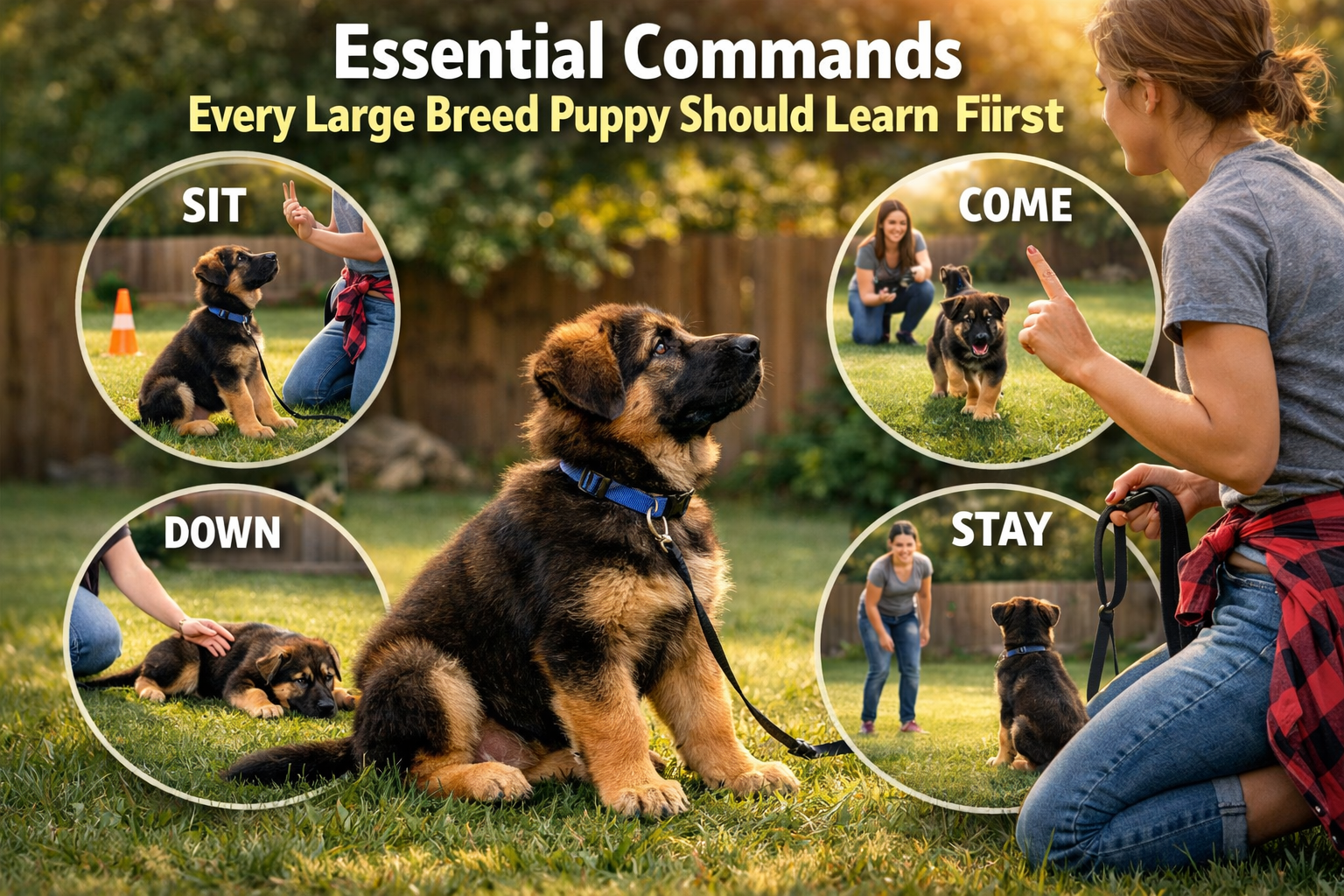
Training a large breed puppy isn’t just about teaching tricks—it’s about building good habits that make life easier and safer as your puppy grows. A 20-pound puppy can quickly become a 100-pound adult, making early obedience training one of the best investments you can make.
The good news is you don’t need to teach dozens of commands right away. A handful of foundational cues will give your puppy the skills they need to become a calm, polite companion while strengthening the bond between you.
In this guide, we’ll cover the seven essential commands every large breed puppy should learn first and offer practical tips to help make training enjoyable and successful.
Why Basic Commands Matter for Large Breed Puppies
Large breed puppies mature more slowly than smaller dogs, but they also grow incredibly fast. Even at four or five months old, many large breed puppies have enough size and strength to unintentionally knock people over or pull hard on a leash.
Teaching basic obedience early helps:
- Improve safety at home and in public
- Prevent unwanted behaviors from becoming habits
- Build confidence in new environments
- Strengthen communication between you and your puppy
- Prepare for more advanced training later
Training sessions also provide valuable mental stimulation, helping reduce boredom and destructive behaviors.
Sit
“Sit” is usually the very first command puppies learn because it’s simple and incredibly useful.
Why it matters
Teaching your puppy to sit encourages calm behavior instead of jumping, barking, or lunging.
Use “Sit” before:
- Greeting visitors
- Receiving meals
- Going outside
- Crossing streets
- Getting into the car
How to teach it
- Hold a treat close to your puppy’s nose.
- Slowly move it upward over their head.
- As they naturally lower their rear, say “Sit.”
- Immediately reward with praise and a treat.
Practice several short sessions each day.
Stay
Once your puppy understands “Sit,” it’s time to introduce “Stay.”
Why it matters
Stay teaches patience and impulse control.
It’s especially useful for:
- Opening doors safely
- Preventing dashing into traffic
- Greeting people politely
- Vet visits
- Grooming
Training tips
- Ask your puppy to sit.
- Hold your palm out like a stop sign.
- Say “Stay.”
- Take one small step backward.
- Return and reward.
Increase distance and time gradually.
Come
A reliable recall may be the most important command your dog ever learns.
Why it matters
A strong “Come” command can prevent dangerous situations if your puppy slips a leash or escapes the yard.
How to teach it
- Start indoors.
- Say your puppy’s name followed by “Come!”
- Reward generously when they reach you.
- Keep your voice cheerful and exciting.
Never punish your puppy after they come to you, even if they were misbehaving beforehand.
Leave It
Large breed puppies love investigating the world with their mouths.
Unfortunately, that often includes rocks, socks, trash, and other dangerous objects.
Why it matters
“Leave It” helps prevent:
- Eating toxic foods
- Swallowing foreign objects
- Picking up garbage
- Chasing wildlife
- Chewing on objects
Teaching the command
- Place a treat in your closed hand.
- Let your puppy sniff it.
- Wait until they stop trying to get it.
- Say “Leave It.”
- Reward with a different treat from your other hand.
Your puppy learns that ignoring something often earns an even better reward.
Down
“Down” teaches your puppy to lie calmly on the floor.
Why it matters
This command encourages relaxation and helps puppies settle during busy situations.
It’s useful for:
- Family dinners
- Coffee shops
- Veterinary waiting rooms
- Guests visiting your home
Teaching Down
- Begin with your puppy sitting.
- Move a treat slowly toward the floor.
- Guide it outward once their elbows touch the ground.
- Reward immediately.
Keep sessions short and positive.
Heel
Loose-leash walking starts with teaching your puppy where you’d like them to walk.
Heel doesn’t need to be a competition-level position. For most families, it simply means walking calmly beside you without pulling.
Why it matters
Large dogs that pull can become difficult and even dangerous to walk as adults.
Teaching Heel early helps:
- Prevent leash pulling
- Make walks more enjoyable
- Improve focus around distractions
- Build good walking habits
Simple training method
- Hold treats near your leg.
- Reward your puppy for staying beside you.
- Take only a few steps at first.
- Gradually increase distance.
Keep training fun and stop before your puppy becomes frustrated.
Tips for Successful Puppy Training
Consistency matters more than long training sessions.
For the best results:
- Keep sessions between 5–10 minutes.
- Train several times each day.
- Use positive reinforcement.
- Reward immediately after correct behavior.
- End every session on a success.
- Practice in different environments as your puppy improves.
Remember that puppies learn through repetition. Progress won’t always be perfectly linear, and that’s completely normal.
Common Training Mistakes to Avoid
Even well-intentioned owners can accidentally slow progress.
Avoid these common mistakes:
Training for too long
Young puppies have short attention spans.
Repeating commands
Instead of saying “Sit, sit, sit,” give the command once and guide your puppy if needed.
Inconsistent rules
If jumping is allowed sometimes but discouraged other times, your puppy becomes confused.
Skipping rewards too soon
Continue rewarding successful behavior while gradually reducing treats over time.
Expecting perfection
Your puppy is still learning. Celebrate small improvements.
Frequently Asked Questions
Which command should I teach first?
Most trainers recommend starting with Sit, followed by Come, Stay, and Leave It.
How long should training sessions last?
Five to ten minutes is ideal for young puppies. Several short sessions throughout the day are much more effective than one long session.
Should I use treats every time?
Treats are extremely helpful during the learning phase. As your puppy becomes more reliable, you can gradually replace some food rewards with praise, toys, or affection.
At what age should I start training?
Training can begin as soon as your puppy comes home, usually around 8 weeks of age. Young puppies are capable of learning basic commands through positive reinforcement.
Final Thoughts
Teaching your large breed puppy these seven essential commands creates the foundation for a lifetime of good behavior. Rather than trying to teach everything at once, focus on mastering one skill before moving to the next.
With patience, consistency, and plenty of positive reinforcement, your puppy will grow into a confident, well-mannered companion that’s enjoyable to live with and easy to take anywhere.
Remember, training isn’t just about obedience, it’s about building trust and strengthening the relationship you share with your dog.
Trusted Resources
American Animal Hospital Association. (2015). Canine and feline behavior management guidelines. https://www.aaha.org
American Kennel Club. (n.d.). Basic obedience training for puppies. https://www.akc.org
American Veterinary Medical Association. (n.d.). Dog behavior and training. https://www.avma.org
Overall, K. L. (2013). Manual of clinical behavioral medicine for dogs and cats. Elsevier.