Loose Leash Walking When Your Dog Outweighs You: Leverage & Technique
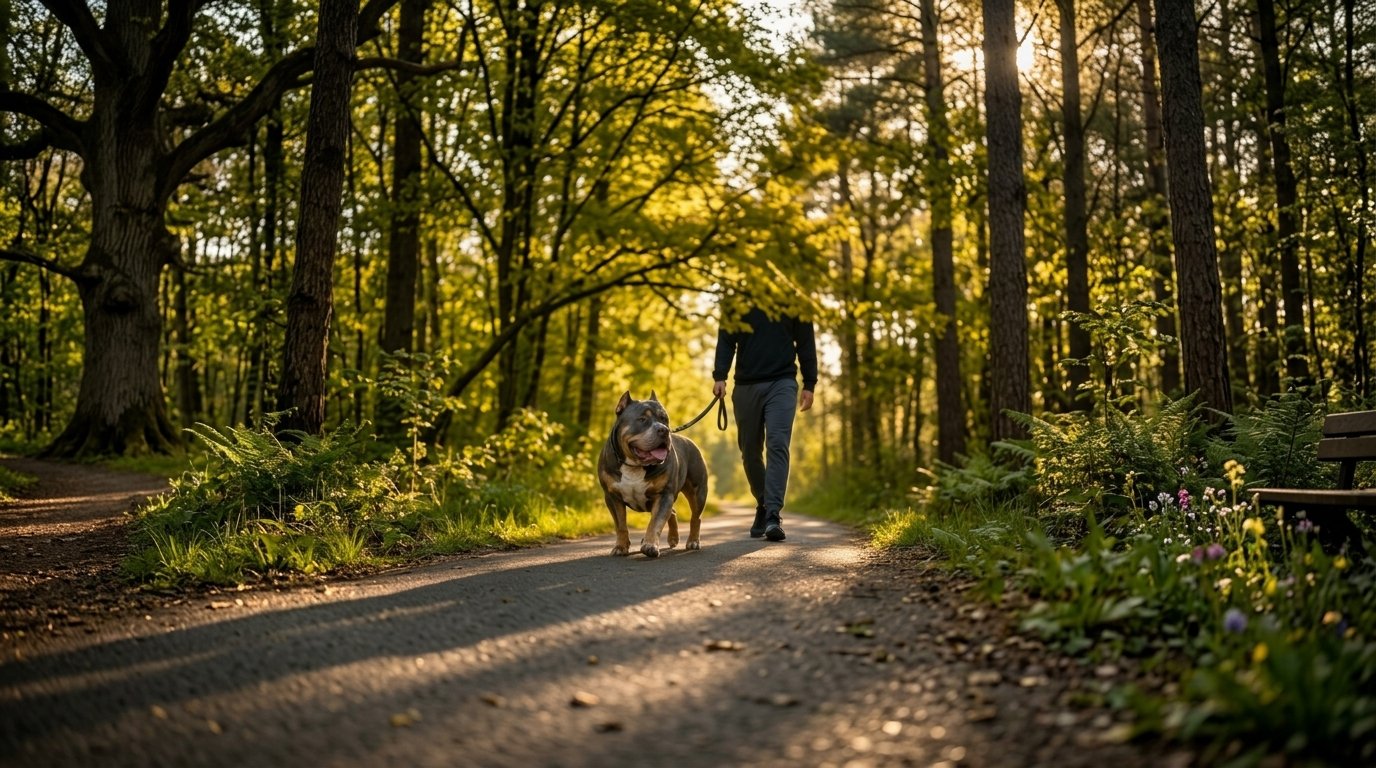
If you own an American Bully, Mastiff, Rottweiler, or any other muscular, heavy-set breed, you already know the struggle. When an 80- or 90-pound dog decides they suddenly need to greet a squirrel, chase a cat, or say hi to a neighbor, brute force isn’t going to cut it. Unless you moonlight as a powerlifter, trying to muscle a large breed dog on a leash is a fast track to a sore shoulder, a strained back, or taking a nose-dive onto the sidewalk.
Walking a strong dog safely isn’t about being stronger than them. It comes down to basic physics, proper leverage, and teaching your dog that pulling actually gets them nowhere.
Here is how you can regain control of your walks, protect your joints, and keep both you and your big dog safe.
Fix Your Posture and Center of Gravity
When a big dog lunges or pulls hard, our natural instinct is to lock our arms straight out and lean backward. Unfortunately, this puts all the strain directly on your upper body and gives your dog maximum leverage against you.
Instead, change your stance:
Keep your elbows tucked. Bend your elbows and anchor your hands close to your waist or belly button. Your core and hip muscles are much stronger than your arms. Keeping the leash close to your center of gravity prevents the dog from snapping your arm forward.
Bend your knees slightly. A rigid, straight-legged stance makes it easy for a heavy dog to pull you off balance. Keeping a flexible, athletic posture gives you instant stability.
Turn your hips. If your dog lunges forward, turn your hips slightly sideways to the direction of the pull. This puts you in a grounded stance, making it almost impossible for your dog to yank you off your feet.
Upgrade Your Gear
If you have a powerful breed like an American Bully, attaching a standard 6-foot leash directly to a neck collar can be risky. A strong pull can damage their trachea, and if they catch you off guard, they can easily pull the leash right out of your hands.
Here are gear setups that work wonders for big dogs:
Front-Clip Harnesses: Unlike standard back-clip harnesses (which actually encourage dogs to pull like sled dogs), a front-clip harness attaches to the center of the dog’s chest. When your dog pulls forward, the leash naturally turns their chest back toward you, steering them out of the pull without choking them.
Head Halters: For dogs that are exceptionally strong or reactive, a head halter gives you control over where their head goes. Where the head goes, the body follows. It requires gentle handling, but it completely removes your dog’s physical pulling power.
Thick, Non-Slip Leashes: Avoid retractable leashes entirely. They give large dogs too much momentum and can easily snap or burn your hands. Opt for a 4- to 6-foot heavy-duty nylon or leather leash with a padded handle.
The "Two-Handed Lock" Technique
Personal experience taught me never to wrap a leash around your wrist or fingers. If an American Bully lunges suddenly, a wrapped leash can fracture bones in your hand or wrist.
Use the two-handed anchor method instead:
Put your thumb through the leash loop and close your anchor hand into a fist. Hold your anchor hand firmly against your hip or waist on the side your dog walks.
Use your second hand lower down on the leash to guide and adjust length as needed. If your dog pulls, your waist takes the force of the pull, not your fingers or shoulder.
Break Their Momentum Early
Momentum is a big dog’s greatest asset. Once a heavy dog gets up to speed, stopping them takes three times the effort. The secret is stopping the pull before they build speed.
Watch for body language: Learn your dog’s warning signs. Is their head locked high? Are their ears pinned forward? Are they staring intently at something down the street?
Redirect before the lunge: As soon as you notice that intense focus, redirect their attention back to you using a high-value treat, or a squeaky sound.
Change direction: If your dog starts bracing themselves to pull, simply turn 180 degrees and walk the other direction. Do not pull back in a game of tug-of-war. Just turn around, walk away, and reward them when they catch up to walk beside you.
Teach the "Be an Anchor" Game
Teach your dog that pulling stops all forward progress, practice this simple exercise in your driveway or backyard:
Start walking forward with your dog on a leash. The moment the leash goes taut, stop dead in your tracks. Become a tree trunk. Wait silently without yelling or tugging back.
As soon as your dog takes a step back, turns around, give them a treat and resume walking.
It takes consistency, especially with stubborn or high-drive breeds, but your dog will quickly realize that a tight leash means stopping, while a loose leash means moving forward.
Final Thoughts
Walking a big, powerful dog doesn’t have to feel like a workout session or an emergency waiting to happen. By pairing smart leverage techniques with the right gear and clear boundaries, you can enjoy relaxed, confident walks with your American Bully or large breed companion every single day.
Trusted Resources
1. American Society for the Prevention of Cruelty to Animals. (n.d.). https://www.aspca.org/about-us/aspca-policy-and-position-statements/position-statement-training-aids-and-methods
2. American Veterinary Society of Animal Behavior. (2021). https://avsab.org/wp-content/uploads/2021/08/AVSAB-Humane-Dog-Training-Position-Statement-2021.pdf
3. Royal Society for the Prevention of Cruelty to Animals. (n.d.). Train your dog to stop pulling on the lead. https://www.rspca.org.uk/adviceandwelfare/pets/dogs/training/walknicely
4. University of California, Davis, School of Veterinary Medicine. (n.d.). Loose-leash walking. https://healthtopics.vetmed.ucdavis.edu/health-topics/canine/loose-leash-walking