Spotlight – Komondor
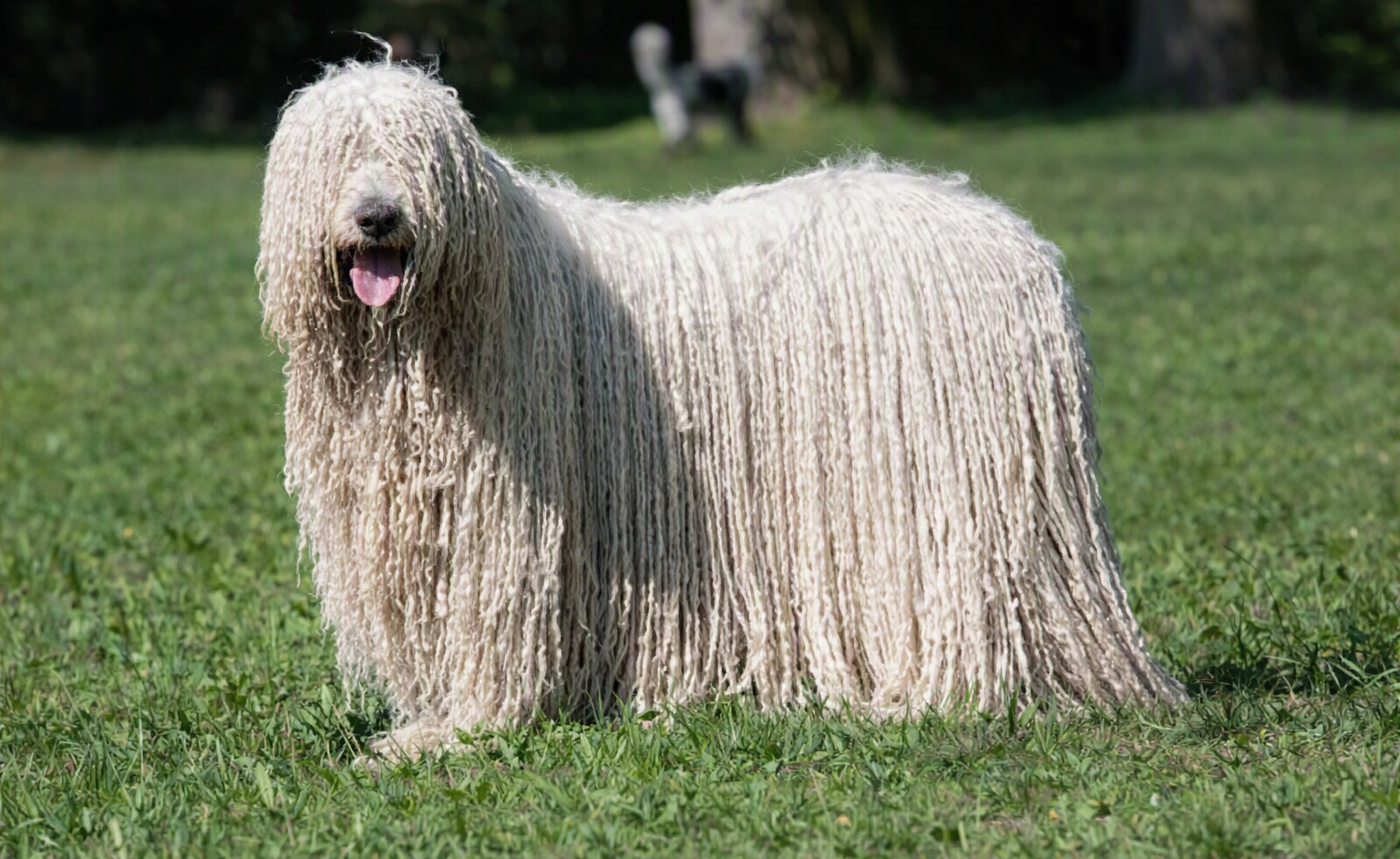
If you saw a Komondor walking down the street, you might do a double take. With its long, white, corded coat, this large dog looks less like a dog and more like a walking mop!
But underneath those unusual cords is a brave, loyal and independent livestock guardian with a long history of protecting sheep. The Komondor’s appearance may be what first gets your attention, but its personality and guardian instincts are just as important to understand before bringing one home.
AT A GLANCE
The Komondor is definitely a large breed.
Breed: Komondor
Origin: Hungary
Weight: 80–100 pounds
Height: 25.5–27.5 inches
Coat: Long, white, naturally corded
Personality: Loyal, courageous, independent and protective
Best known for: Its distinctive corded coat and livestock guardian instincts.
Its size is impressive, but its coat is what really gets everyone’s attention.
Komondors have a naturally corded white coat that can make them look almost like they’re wearing a shaggy blanket. Puppies start out with a softer, curly coat, and the characteristic cords develop as they mature.
That beautiful coat isn’t exactly low-maintenance, though. You do not brush a Komondor in the traditional sense. Instead, the cords need to be separated by hand to keep them from forming large, solid mats. Bathing can also be an adventure because all that hair takes a long time to dry completely.
In other words, this probably isn’t the breed for someone looking for an easy-care coat.
HISTORY
The Komondor originated in Hungary, where it was developed as a livestock guardian. Its job was to live with and protect sheep from predators.
Unlike herding breeds that work closely with a handler and move livestock from one place to another, livestock guardian dogs were expected to watch over their animals and make decisions independently when necessary.
This history helped shape the Komondor’s personality. These dogs needed to be brave, confident and capable of responding to potential threats without waiting for instructions from a person.
The Komondor’s famous white corded coat also served an important purpose. The thick coat provided insulation while the dog worked outdoors in Hungary’s changing weather. Its unusual appearance could also help the dog blend in with the sheep it was protecting.
Today, the Komondor may be more likely to live in a family home than guard a flock of sheep, but its guardian instincts are still very much a part of the breed.
TEMPERAMENT
The Komondor is loyal, courageous and highly protective of its family and home.
These dogs tend to form strong bonds with the people they know and trust. With strangers, however, they may be reserved or suspicious. That doesn’t mean a Komondor should be aggressive, but owners should understand that this breed was developed to recognize and respond to potential threats.
Another important part of the Komondor’s personality is its independence.
This isn’t necessarily a dog that will immediately do something simply because you ask. Komondors were bred to think for themselves, and that trait can make training a little different from working with a breed that is constantly looking for direction from its owner.
A confident and well-socialized Komondor can be calm and affectionate with its family while remaining naturally watchful around unfamiliar people and situations.
ARE KOMONDOR'S GOOD FAMILY DOGS?
Komondors can be loving and loyal family dogs, but they are not necessarily the best choice for every family.
They can develop strong attachments to their families and may be gentle and affectionate with the people they know well. However, their protective instincts mean that early socialization is especially important.
Children should also be taught how to interact appropriately with a large dog. As with any breed, interactions between dogs and young children should always be supervised.
Families who frequently have visitors may need to spend extra time helping their Komondor learn how to calmly handle guests entering the home.
The best fit is typically a family that understands guardian breeds and is willing to consistently train and socialize their dog.
TRAINING A KOMONDOR
Training a Komondor should begin early.
Because this is a large and powerful dog with natural guardian instincts, teaching good manners while the dog is still a manageable puppy is extremely important.
Basic commands, loose-leash walking and appropriate behavior around people and other animals should all be part of early training.
Socialization is equally important. A Komondor puppy should have positive, controlled exposure to different people, environments, sounds and situations.
Training should be consistent and patient. Harsh methods are unnecessary and may damage the relationship between you and your dog. Positive reinforcement and clear expectations are generally a much better approach.
Because of the Komondor’s independent nature, owners may need to be patient. This is a dog that was bred to think for itself, and that personality doesn’t disappear simply because the dog now lives in a house instead of guarding sheep.
EXERCISE NEEDS
The Komondor is not necessarily a high-energy dog that needs hours of intense exercise every day.
Its original job was to guard livestock, which required endurance and awareness rather than constant running. Many Komondors are calm indoors when their physical and mental needs are being met.
An adult Komondor is generally fairly inactive and doesn’t require extensive daily exercise, but should still receive regular walks and opportunities for activity. The Komondor Club of America specifically notes that dogs without access to a fenced yard or large run should generally be walked two or three times a day.
Mental stimulation is important, too. Training sessions, problem-solving activities and appropriate activities that allow the dog to use its brain can help prevent boredom.
GROOMING
The Komondor’s coat is one of its most recognizable features and one of the biggest commitments that comes with owning the breed.
Komondor puppies begin with a softer, curly coat. As they mature, the coat begins forming the long cords that give the adult dog its distinctive appearance.
The coat isn’t brushed in the traditional sense. Instead, the cords need to be separated by hand to help prevent them from forming large mats.
Bathing can also be time-consuming. A fully corded Komondor has a tremendous amount of coat, and getting all those cords clean and completely dry can take significant time.
If you’re looking for a low-maintenance large dog, the Komondor’s grooming requirements may be one of the biggest reasons to consider another breed.
HEALTH CONCERNS
One nice thing about the Komondor is that it isn’t known for having a long list of breed-specific hereditary problems. However, like any large dog, there are health concerns prospective owners should understand.
Hip dysplasia is one concern seen in the breed. The Komondor Club of America recommends that breeding dogs have their hips evaluated and certified through the Orthopedic Foundation for Animals (OFA) or PennHIP.
Bloat, or gastric dilatation-volvulus (GDV), is another concern. Large, deep-chested dogs can be susceptible to this potentially life-threatening emergency. With GDV, the stomach fills with gas and can twist, cutting off blood supply. Anyone who owns a large dog should learn the warning signs and know where to seek emergency veterinary care.
The Komondor Club of America also recommends eye evaluations by a board-certified veterinary ophthalmologist for breeding dogs. Its current health statement lists hip evaluation, eye evaluation and dentition certification as required health testing, with elbow dysplasia and degenerative myelopathy testing listed as highly recommended electives.
That doesn’t mean every Komondor will develop a health problem. Choosing a responsible breeder who performs the recommended health screenings can help you make a more informed decision when selecting a puppy.
As always, regular veterinary examinations, appropriate nutrition, maintaining a healthy weight and paying attention to changes in your dog’s behavior can help support your Komondor’s overall health.
WHAT'S IT LIKE LIVING WITH A KOMONDOR
Living with a Komondor can be very rewarding, but it isn’t always simple.
You’ll be sharing your home with a large, powerful dog that takes its role as a guardian seriously. Your Komondor may be deeply affectionate with your family while being much more reserved around unfamiliar people.
Those beautiful white cords require regular attention, and bathing and drying a large corded dog is not a quick job.
Visitors may also require some planning. A Komondor should learn how to behave appropriately around guests, but owners should respect the breed’s naturally protective personality rather than expecting it to behave like a social butterfly.
On the positive side, these dogs are incredibly loyal and can form close relationships with their families. For someone who appreciates an independent guardian breed, living with a Komondor can be a very special experience.
IS A KOMONDOR RIGHT FOR YOU?
The Komondor can be an excellent dog for the right owner, but this breed isn’t a good match for everyone.
You may be a good fit for a Komondor if you:
- Understand and appreciate guardian breeds
- Are comfortable working with an independent dog
- Have time for early training and continued socialization
- Can manage a large and powerful dog
- Are prepared for significant coat care
- Appreciate a dog that may be reserved around strangers
The Komondor may not be the best choice if you:
- Want a dog that loves meeting everyone
- Prefer a highly obedient, eager-to-please personality
- Don’t have time for regular grooming and coat maintenance
- Frequently leave your dog alone for long periods
- Are not prepared to train and socialize a large guardian breed
The Komondor’s unusual appearance may attract a lot of attention, but potential owners should make their decision based on the breed’s temperament and needs, not just that unforgettable coat.
FINAL THOUGHTS
The Komondor may look like a walking mop, but underneath those famous white cords is a serious livestock guardian with centuries of history behind it.
This is a brave, loyal and independent breed that can form strong bonds with its family. However, its protective instincts, large size and demanding coat mean that it needs an owner who understands what comes with living with a guardian breed.
For the right person or family, the Komondor can be a devoted and fascinating companion.
Just be prepared to answer plenty of questions when you take your four-legged mop for a walk.
TRUSTED RESOURCES
American Kennel Club. (n.d.). Komondor. Retrieved September 1, 2026, from https://www.akc.org/dog-breeds/komondor/
American Kennel Club. (n.d.). Komondor history: From livestock guardians to playful pets. Retrieved September 1, 2026, from https://www.akc.org/expert-advice/dog-breeds/komondor-history/
American Kennel Club. (n.d.). Komondor facts you may not know. Retrieved September 1, 2026, from https://www.akc.org/expert-advice/dog-breeds/fun-facts-komondor/
Komondor Club of America. (n.d.). About the Komondor. Retrieved September 1, 2026, from https://komondorclubofamerica.org/about-the-komondor/
Komondor Club of America. (n.d.). Frequently asked questions. Retrieved September 1, 2026, from https://komondorclubofamerica.org/frequently-asked-question/
Orthopedic Foundation for Animals. (n.d.). Canine Health Information Center (CHIC) program. Retrieved September 1, 2026, from https://ofa.org/chic-programs/
VCA Animal Hospitals. (n.d.). Komondor. Retrieved September 1, 2026, from https://vcahospitals.com/know-your-pet/komondor